How to use AI for writing without losing your voice
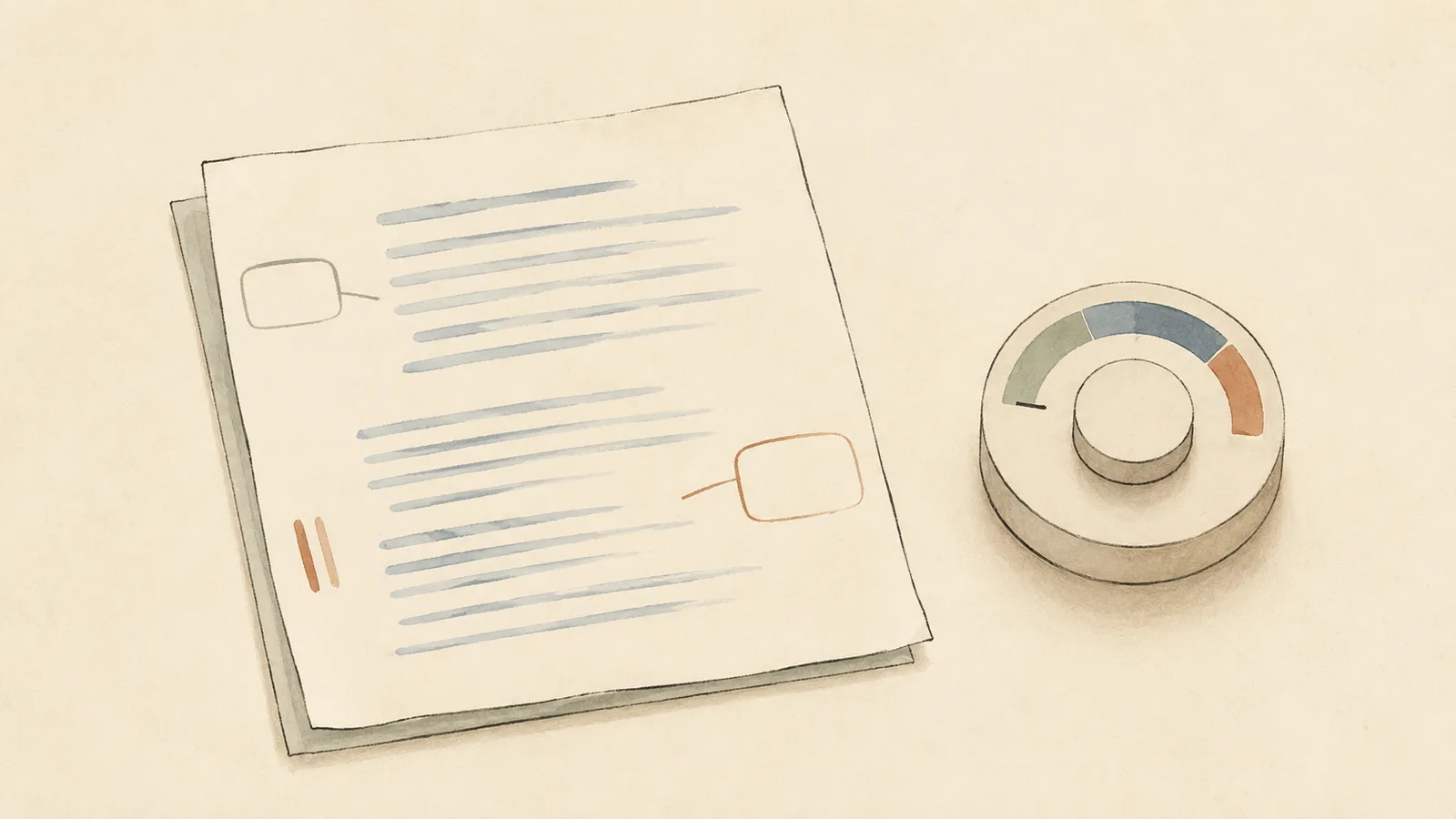
Draft in your own words, ask for focused editorial help, and choose how much assistance you want while keeping the decisions and authorship yours.
To use AI for writing without it sounding like AI, start with a draft you wrote yourself. Give the companion a specific editorial task: identify an unsupported claim, question an unclear passage, or point out unnecessary wording. Revise the passage in your own words, then decide whether the result still says what you meant in a way you would choose to say it.
That is the approach described in Poreover AIWriter's Presence craft reference: the person thinks first, the dial adjusts the amount of assistance, and authorship stays with the writer. Treat the process below as a working practice for protecting your decisions about meaning, rhythm, and vocabulary.
Draft before you ask for feedback
Begin with the thing you want to say to one particular reader. Write the claim, the incident that prompted it, or the uncertainty you are trying to resolve. Leave a note where you need evidence. Allow a paragraph to remain awkward while you work out its point.
For this practice, avoid asking for an introduction before you have written your own opening. Instead, write a provisional opening and underline the sentence that matters most. If you cannot find that sentence, make a private note beginning, "The part I want to explain is..." Continue from there before requesting help.
Keep the first draft available for comparison. Mark a few phrases you want to preserve and write down why: a precise observation, a restrained joke, a particular hesitation, or the way you address the reader. Use these notes as your own editing brief rather than asking the AI to define your voice for you.
Give the AI an editorial job with a boundary
Ask for feedback you can act on. For example: "Point to the sentence where my argument needs evidence. Explain the gap and leave the wording to me." Or: "Identify a phrase that repeats an idea already expressed nearby. Quote the phrase and explain the repetition."
Poreover AIWriter asks the companion to name the passage and ground its advice in a craft principle, such as William Zinsser's guidance on clutter or Orwell's guidance on word choice. The intended result is a specific observation with a reason you can assess, followed by work for you to do.
Use that requirement when reviewing the feedback. If a note only says that a paragraph needs polish, ask it to identify the problem. If it recommends a different word, compare the meanings before considering the sound. If it challenges the claim, return to your evidence rather than treating the challenge as a conclusion.
Choose how much assistance you want
Poreover AIWriter's Presence craft reference defines three dial positions. The names describe different kinds of presence during writing, with greater assistance intended to provide sharper feedback while keeping the piece yours.
| Mode | Kind of assistance | Your part of the work |
|---|---|---|
| deep | No generated writing or AI rewriting; prompts keep attention on your own thinking. | Draft, question, and revise in your own words. |
| dialogue | A Socratic question or nudge; wording suggestions are marked, and passages are not rewritten. | Answer the question and make the revision yourself. |
| diabolical | Editorial critique that names a weakness, a craft principle, and a possible fix; limited rewriting only when requested. | Judge the critique and decide what belongs in the draft. |
Begin in deep when you want room to find the thought. Try dialogue when a question would help you examine it. Use diabolical when you want a more exacting critique of a passage you have already written. Choose the setting for the task in front of you, without treating the highest position as a destination.
The boundaries in Presence still apply in diabolical mode. A request to examine an argument is not a request to supply a new argument. If you ask for a sentence-level rewrite, specify the sentence and the meaning it must retain, then inspect the suggestion before adopting any part of it.
Practice on one passage
Here is an example written for this guide: "I kept the old chair because it belonged to my aunt, although it never fitted under the table and made the kitchen awkward to use." Suppose you want to keep the tension between affection and inconvenience.
In a sample dialogue exchange, you might ask for a question about that tension. A useful question to consider would be, "What does keeping the chair show about your attachment to your aunt?" Answer it in your notes before deciding whether the paragraph needs another detail.
In diabolical, you could request a critique of the paragraph's emphasis while reserving the wording. Consider a suggestion to make inconvenience the main subject, then compare it with your intention. If the point is your attachment, revise toward that point or reject the suggestion with that reason.
If you later request a shorter version of the sentence, check that it still includes the aunt, the chair, and the inconvenience. A smooth replacement that removes the attachment would fail this particular brief. Your stated purpose supplies the standard for accepting the edit.
Keep judgment in the revision
Read each proposed change against the original. Name what it does before accepting it: clarifies a reference, removes repetition, shifts emphasis, or changes a claim. If you cannot explain the change, pause and work through the sentence yourself.
Check any factual addition at its source. If a suggestion supplies a quotation or an attribution, open the publication and verify the wording and context. Poreover AIWriter's Presence principle places the decision with the person; use that responsibility as a reason to inspect the evidence, not merely the fluency of the proposed sentence.
Keep uncertainty when it is part of your meaning. In an illustrative draft, "I think the meeting changed her mind" describes an inference. "The meeting changed her mind" states the conclusion without that qualification. Choose between them according to what you know, even if one version sounds more decisive.
Finish with a pass in your own words
After working through the feedback, return to deep and read the draft without requesting another round of suggestions. Compare it with your opening brief. Restore a phrase if the revision has lost an observation you wanted to keep; cut a phrase if you kept it only because it sounded impressive.
End the session by choosing one paragraph, requesting one editorial observation, and writing the revision yourself. If this way of working fits, Poreover AIWriter is in an invite-only beta.