How to edit your own writing without losing your meaning
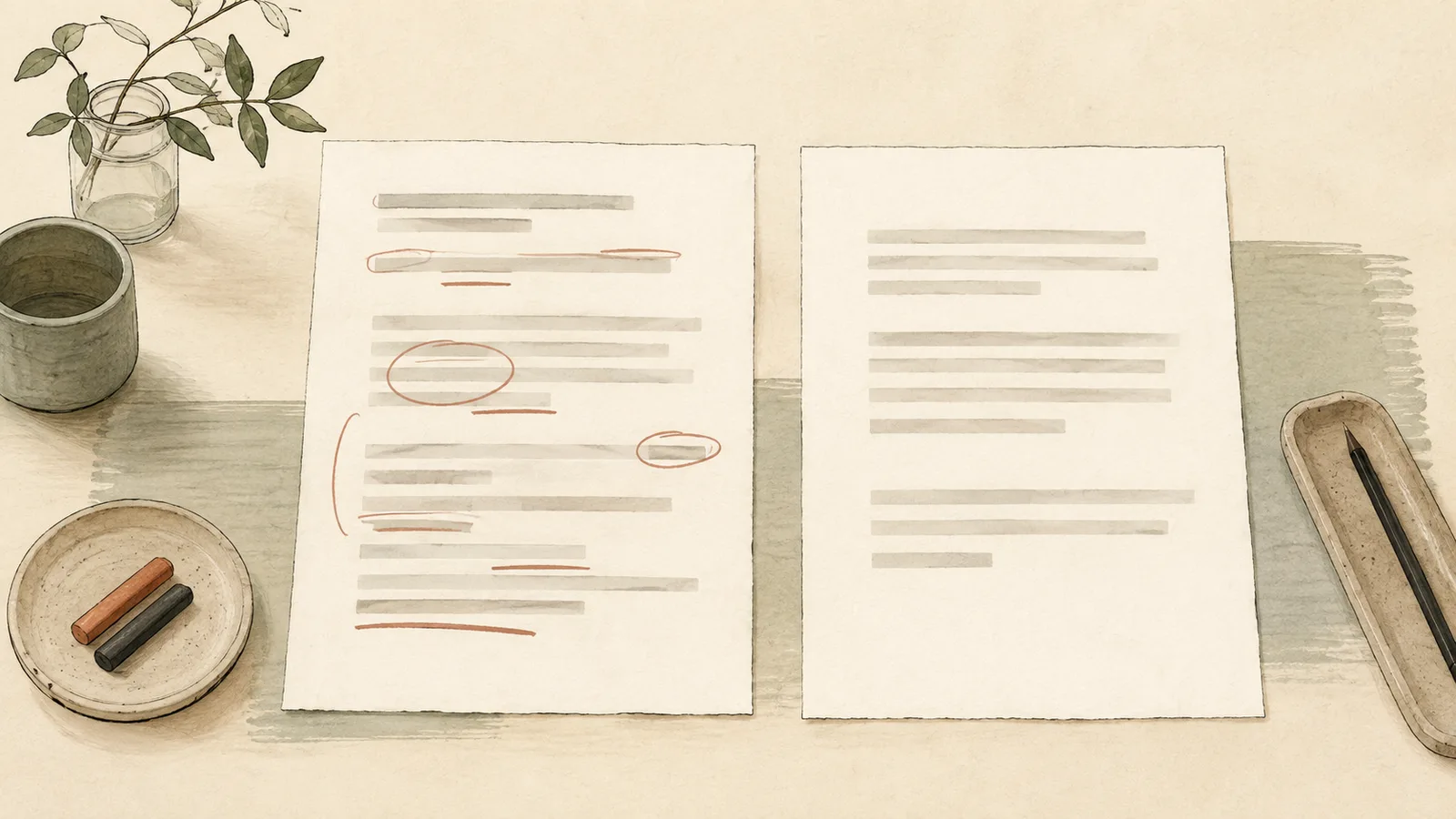
Edit your draft in separate passes for structure, clutter, verbs, and accuracy, using principles from Zinsser, Orwell, and Strunk and White.
To edit your own writing, work from the whole piece down to the sentence. State the point you want to make, check that each paragraph supports it, then revise clutter and weak constructions. Finish by checking that your changes preserve the facts, qualifications, and emphasis you intended. Treat this as a sequence of separate passes, so you can give each decision your attention.
Use three named guides for the sentence work: William Zinsser's On Writing Well for simplicity and clutter, George Orwell's Politics and the English Language (1946) for deliberate word choice, and William Strunk Jr. and E. B. White's The Elements of Style for the instruction to "omit needless words." The workflow below combines those principles with original practice exercises.
Start by deciding what the draft must do
Above your draft, write a private sentence beginning, "I want the reader to understand..." Make the ending specific enough to test. For an essay about a library, you might write, "I want the reader to understand why the evening opening hours matter to shift workers."
Now label each paragraph with its purpose: introducing the proposal, describing a worker's experience, presenting evidence, or considering a cost. Mark any paragraph whose purpose you cannot explain. Decide whether to move it, revise it, or put it aside before spending time on its punctuation.
Try this on the opening in particular. If your first paragraph announces a broad topic and your second states the actual proposal, make a copy with the second paragraph first. Compare the versions against your private sentence. Keep the opening that gives your intended reader the necessary starting point, including context they would otherwise lack.
Use Zinsser's test for clutter
In the "Simplicity" and "Clutter" chapters of On Writing Well, Zinsser argues for removing language that serves no useful purpose: inflated phrasing, redundant modifiers, and constructions that obscure the thought. His standard is useful work, rather than formality for its own sake. Zinsser's chapter excerpts, from the 1998 edition.
Apply that standard with a temporary deletion. Bracket a phrase, read the sentence without it, and describe what has disappeared. If you cannot name a loss of meaning, tone, or necessary connection, try the shorter version. If the phrase establishes uncertainty or a contrast, keep it until you can express that function better.
In the practice sentence "At this point in time, we are currently reviewing the opening hours," try "We are reviewing the opening hours." Both versions place the review in the present. If timing is central to the argument, replace the padding with the particular date or stage you mean, provided your source supports it.
Before-and-after examples of typical edits
These examples were written for this guide to demonstrate possible edits. Use the final column to decide whether a similar change belongs in your draft.
| Editing move | Before | After | Check before accepting |
|---|---|---|---|
| Cut an empty qualifier | The explanation was very clear. | The explanation was clear. | Does the degree matter, and could an example show it? |
| Change passive to active | The opening hours were reviewed by the committee. | The committee reviewed the opening hours. | Is the committee the actor you want to emphasize? |
| Unbury a verb from a noun | We made a decision to extend the trial. | We decided to extend the trial. | Does the revised verb describe the same action? |
| Bring the main verb forward | The editor, after a discussion with the author about the ending, approved the draft. | After discussing the ending with the author, the editor approved the draft. | Does the new order preserve the sequence and participants? |
| Remove a padded introduction | It is important to note that the door closes at six. | The door closes at six. | Does the surrounding paragraph explain why this matters? |
Apply Orwell's six rules with judgment
Near the end of Politics and the English Language (1946), Orwell gives six rules. Paraphrased, they ask you to avoid familiar figures of speech, choose a short word when it serves, remove dispensable words, prefer active constructions, replace unnecessary jargon with everyday equivalents, and break these rules before producing unacceptable language. Orwell's essay, published by the Orwell Foundation.
Use them as prompts during a reading pass. Underline a stock expression and write what you mean beneath it. Circle a formal word and try its ordinary equivalent. Mark a passive sentence and identify the actor before deciding whether to change the construction.
Give the final rule as much attention as the others. Do not replace a precise term with a shorter approximation merely to obey a rule. In a fictional report of a missing notebook, "The notebook was taken" leaves the actor unspecified. Changing it to "A visitor took the notebook" would add an allegation the original sentence does not contain.
Find the action in each sentence
For a focused editing exercise, underline the subject and main verb of a difficult sentence. Then inspect the words between them. Try moving a long interruption before or after the central statement, as in the editor example in the table.
Next, look for an action expressed as a noun beside a general verb: "make a decision," "conduct a review," or "provide an explanation." Try "decide," "review," or "explain." These are options to compare, not substitutions to apply throughout a document without reading it.
Strunk and White pair their advice on concision with guidance to keep related words together. Their instruction to omit needless words does not require every sentence to be short or every detail to disappear. Keep a detail when it contributes something the reader needs. The Elements of Style, fourth edition.
Protect meaning while you revise
Compare an edited paragraph with its original before moving on. Check who acted, what happened, when it happened, and how certain the statement is. Keep the source beside you when the paragraph contains a quotation, date, or reported result.
Pay particular attention to words such as "may," "sometimes," and "in this sample." In the illustrative pair "The change may reduce delays" and "The change reduces delays," removing "may" changes the claim. Do not classify a qualification as clutter until you have checked what it is qualifying.
Read the revised paragraph aloud and mark places where you want a different pause or emphasis. Make those decisions yourself, even if an editing tool has proposed the change. Poreover AIWriter treats assistance as a way to identify a problem and leave the revision with the writer.
For your next editing session, copy one paragraph and make a single pass for clutter. Keep the original beside it, and accept each deletion only after naming what the remaining sentence still needs to say.