Readability scores explained: what Flesch Reading Ease means

Understand Flesch Reading Ease, Flesch-Kincaid grade level, the published score bands, and the limits of measuring writing by word and sentence length.
A readability score estimates reading difficulty from selected features of a text. Rudolf Flesch's Reading Ease formula, published in "A New Readability Yardstick" (1948), uses average sentence length in words and average word length in syllables. A higher score indicates easier reading on its scale. It does not award points for a sound argument or a useful explanation. Flesch's original paper in the Journal of Applied Psychology.
Flesch-Kincaid grade level expresses an estimate on a US school-grade scale instead. J. Peter Kincaid, Robert P. Fishburne Jr., Richard L. Rogers, and Brad S. Chissom developed it for the US Navy in their 1975 report on readability formulas for enlisted personnel. Keep the labels attached to the numbers: a Reading Ease score and a grade-level estimate use different scales. Kincaid and colleagues' report record at the University of Central Florida.
How Flesch Reading Ease is calculated
Flesch's 1948 formula can be written using syllables per word as follows:
Reading Ease = 206.835 - 1.015 × (words / sentences) - 84.6 × (syllables / words)
Flesch originally expressed word length as syllables per hundred words, with a coefficient of 0.846. The expression above is mathematically equivalent. His published interpretation uses a scale from 0 to 100, although the arithmetic can produce results outside those endpoints. Flesch, "A New Readability Yardstick," 1948.
For a worked example created for this guide, suppose a passage contains 100 words, five sentences, and 140 syllables. Its averages are 20 words per sentence and 1.4 syllables per word. Substituting those values gives 206.835 - 20.3 - 118.44 = 68.095, or about 68.1.
These hypothetical counts show exactly what information enters the calculation. No input asks whether the passage identifies its subject, explains its terms, or supports its conclusion.
The published Flesch score bands
The difficulty labels below follow Flesch's published bands in his 1948 paper. The audience column follows the school-level guide in Flesch's later How to Write Plain English, chapter 2. These are broad interpretations of text difficulty, not assessments of an individual reader. Flesch's 1948 interpretation and his school-level guide.
| Flesch Reading Ease score | Published difficulty label | Flesch's broad audience guide, US school level |
|---|---|---|
| 90-100 | Very easy | Fifth grade |
| 80-90 | Easy | Sixth grade |
| 70-80 | Fairly easy | Seventh grade |
| 60-70 | Standard | Eighth and ninth grades |
| 50-60 | Fairly difficult | Tenth through twelfth grades |
| 30-50 | Difficult | College |
| 0-30 | Very difficult | College graduate |
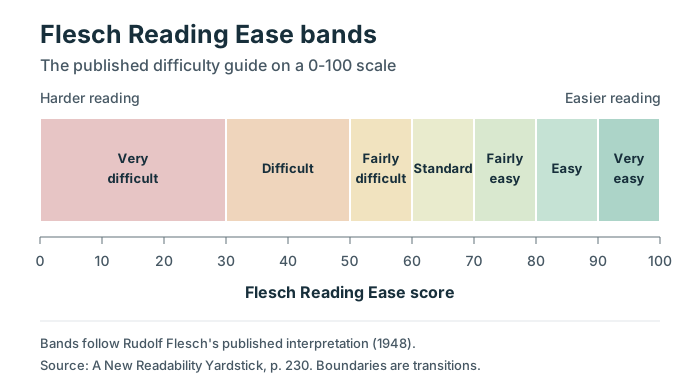
Ranges retain the shared endpoints of the published labels. Treat a boundary such as 70 as a transition in the guide, rather than a sudden change in what a person can understand. Use the table to orient your review, then inspect the passage itself.
How Flesch-Kincaid grade level differs
Kincaid and colleagues' 1975 Navy study recalibrated readability formulas using reading-comprehension testing and Navy training material. The resulting Flesch-Kincaid grade-level formula uses the same two kinds of length averages, with different coefficients:
Grade level = 0.39 × (words / sentences) + 11.8 × (syllables / words) - 15.59
Higher results indicate a higher estimated US grade level. This direction is the reverse of Reading Ease, where higher results indicate easier text. The Navy context describes the formula's development; it does not establish that every reader at a named school level will understand a particular passage. Kincaid et al., Derivation of New Readability Formulas... for Navy Enlisted Personnel, 1975.
Using this guide's hypothetical averages of 20 words per sentence and 1.4 syllables per word gives 7.8 + 16.52 - 15.59 = 8.73. The same invented counts therefore yield Reading Ease of about 68.1 and grade level of about 8.7. Do not compare those numbers as though one calculator had disagreed with the other.
What a length formula cannot judge
The limits follow from the inputs: Flesch's and Kincaid's equations count lengths, without examining the logic linking one claim to the next. That is an inference from the formulas themselves. A short sentence can leave something unexplained; a long technical term can be the precise word the subject requires.
Consider this original example: "Put it there when that is done." Its words are short, but the sentence alone does not identify the object, destination, or preceding task. A reader might understand it in context. Without that context, shortening it further would not supply the missing information.
Try a more explicit instruction for an imagined library desk: "Put the returned atlas on the reference shelf after you check its pages." Judge that revision by whether it names the intended actions and objects. Do not discard useful details merely because they add words or syllables to the calculation.
The Centers for Medicare & Medicaid Services makes a related distinction in its Toolkit for Making Written Material Clear and Effective, Part 6, chapter 1: feedback from intended readers is the test of whether material is understandable and usable. Its advice supports checking the text with people as well as inspecting a score. CMS toolkit introduction to reader feedback.
Use the score to choose a passage to inspect
For revision, calculate the score after you have a draft with a stated purpose. Record which formula you used and which text you included, then use the result to select a passage for closer reading. Avoid choosing a universal target without considering the reader and the task.
In that passage, identify the main action, define any necessary unfamiliar term, and examine sentences that carry several conditions. Try separating a condition from an instruction if that makes the relationship clearer. Preserve connecting words such as "because" when the explanation needs them.
After revising, compare meaning before comparing scores. If the number improved but a qualification disappeared, restore the qualification. If the number fell after you supplied a missing explanation, examine whether the explanation helps your intended reader. Keep a note of the reason for your decision.
For your next draft, choose one paragraph, record its labeled readability score, and ask an intended reader to explain its main point in their own words. Use the difference between what you intended and what they understood to guide the next edit.